
The Citation Crisis
A silent crisis is unfolding for digital publishers and businesses: the vast majority of websites are being indexed but never cited. In the age of AI, indexing is meaningless if it does not lead to a citation in a generative answer. AI models are becoming hyper-selective, ignoring millions of pages of content in favor of a few high-integrity nodes.
The reason for this mass exclusion is not a lack of quality, but a fundamental failure in Data Architecture.
How AI Models Filter for Citations
LLMs and search-integrated AI systems use a "Hierarchy of Trust" when choosing which sources to cite. Most websites fail at the first filter:
- Low Semantic Signal: The content is generic, repetitive, and lacks unique entity data. AI views this as "white noise" and moves on.
- Architectural Fragility: The information is trapped in unstructured formats (like long paragraphs of text without clear headers or metadata). The AI cannot extract facts reliably, so it chooses a more structured source.
- Contextual Isolation: The website exists as an island, with no clear links to authoritative global entities or verified data graphs. The AI has no way to verify the source's claims.
If an AI cannot cross-reference a website's facts against its internal world model, it will never risk citing that website to a user.
Business Impact: Digital Obsolescence
Websites that are not cited by AI models are effectively entering a state of digital obsolescence.
- Visibility Decay: As users shift to AI-first platforms, traditional search traffic will continue to plummet for uncited sites.
- Erosion of Authority: In any industry, the businesses that are cited by AI will be perceived as the "true" experts, while those that aren't will be seen as secondary or outdated.
- Asset Depreciation: A website that is unreadable to AI is a depreciating asset. Its value as a marketing or sales tool reaches zero when the AI-mediated world stops recognizing it.
Common Misconceptions: The Quality Fallacy
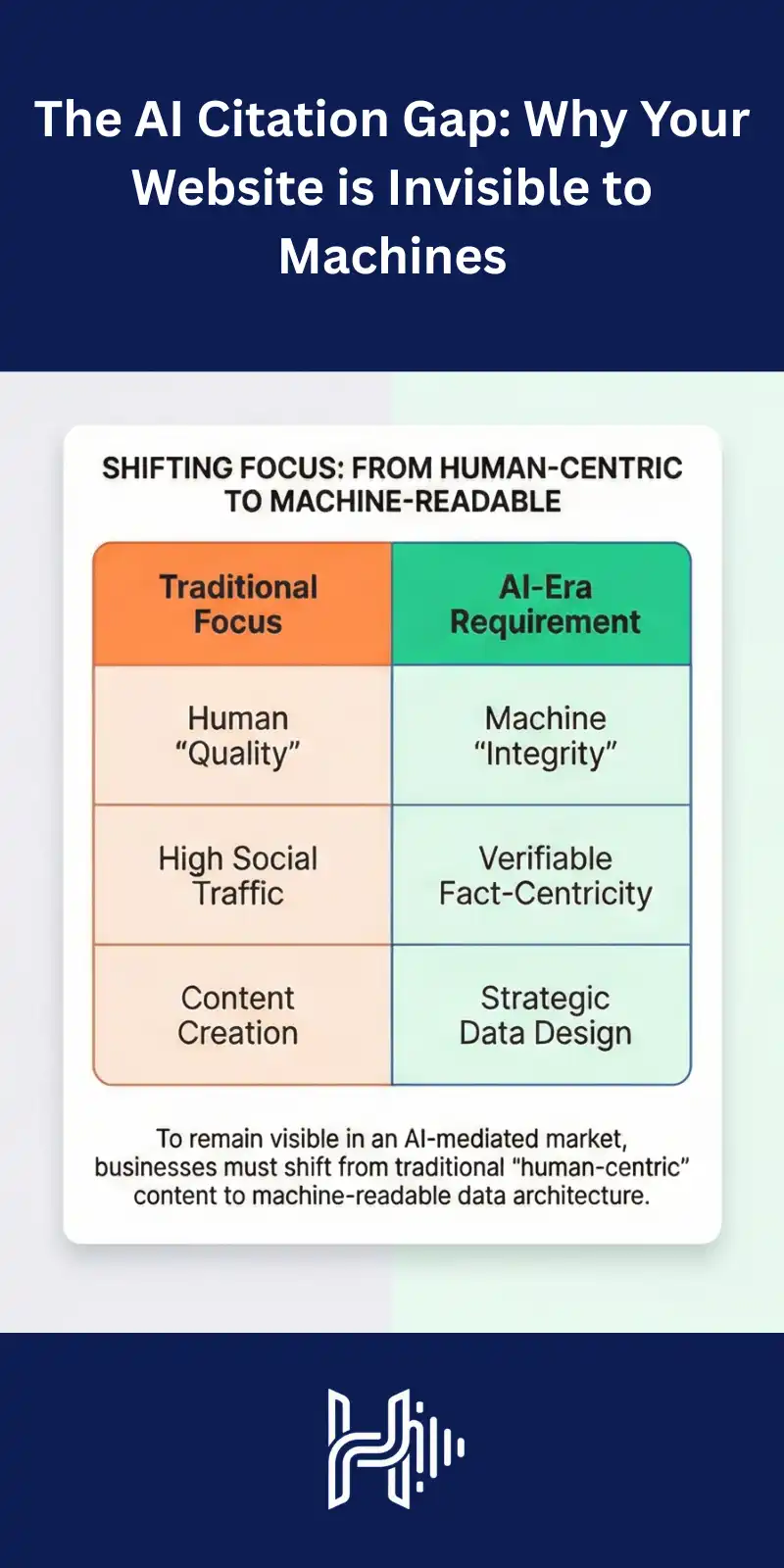
"We write high-quality content" is the most common defense of failing digital strategies. But "quality" is subjective; "integrity" is architectural.
- Quality is for Humans; Integrity is for Machines: A beautifully written 2,000-word essay is useless if an AI cannot find the specific data points it needs to answer a user's prompt.
- Traffic is not Authority: Having high traffic from social media or old SEO tactics does not increase your chances of being cited by an LLM.
- Updates are not Architecture: Simply posting new content does not solve a structural problem. A flawed foundation cannot be fixed by adding more layers of text.
Architectural Insight: Becoming a Citation-Worthy Node
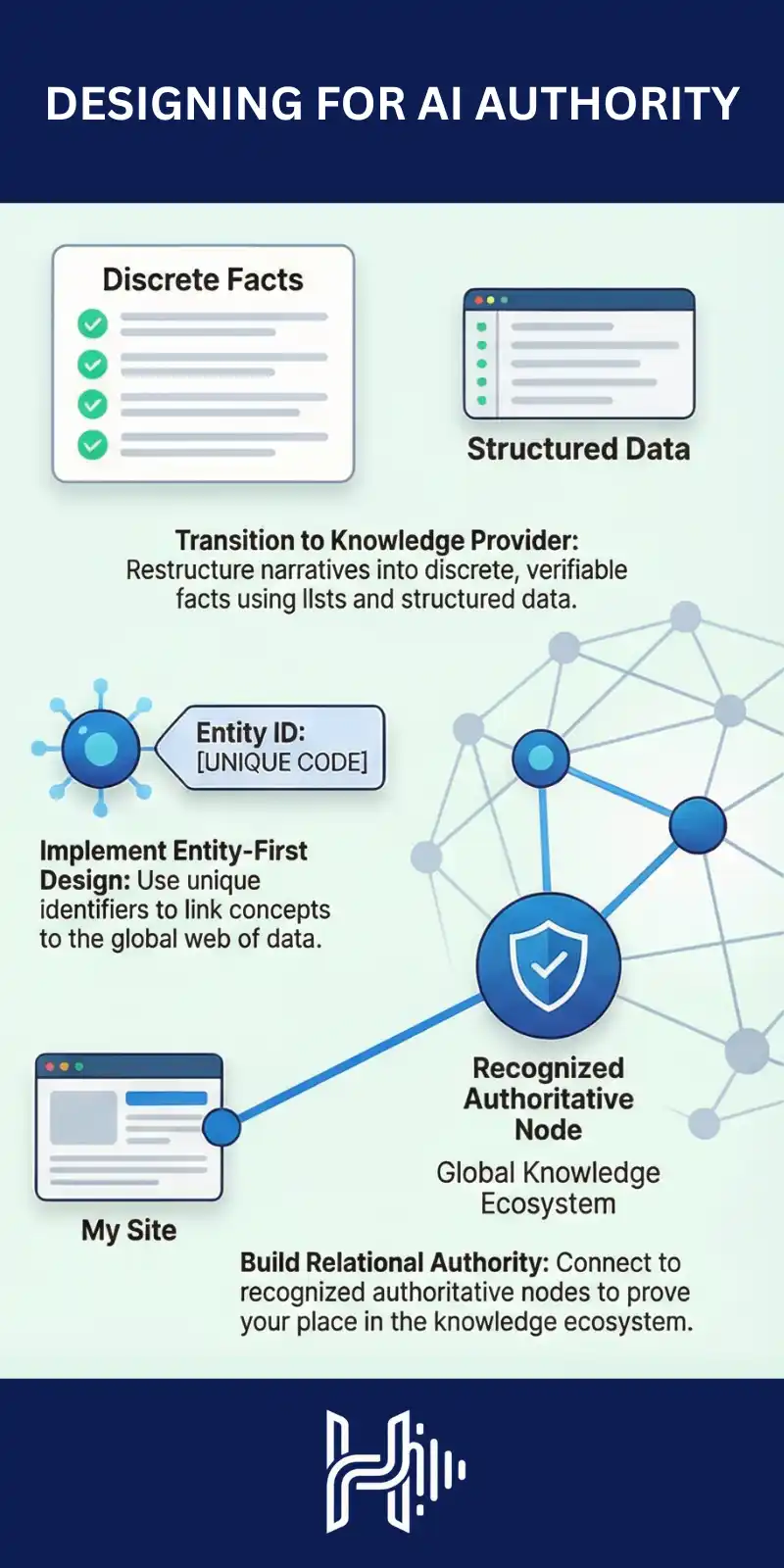
To be cited by AI, a business must transition from being a "publisher" to being a "Knowledge Provider."
- Fact-Centricity: Restructure content around discrete, verifiable facts rather than broad marketing narratives. Use lists, tables, and structured data to make these facts "grab-able" for AI models.
- Entity-First Design: Every page must clearly define the entities it discusses. Use unique identifiers (URI) to link your concepts to the global web of data.
- Relational Authority: Build a network of citations to authoritative sources and ensure your entity is cited by other recognized nodes. This proves to the AI that your business is a trusted part of the knowledge ecosystem.
Visibility today is not found; it is designed. If your architecture is invisible to the machine, your business will be invisible to the market.
TL;DR
- The Citation Gap: AI models ignore most websites not because of quality, but because of poor data architecture and low semantic signals.
- Trust Hierarchy: AI cites sources that are structured, verifiable, and connected to the global knowledge graph.
- Obsolescence Risk: Failure to be cited by AI leads to a rapid decline in visibility and perceived authority.
- Integrity over Quality: Success requires shifting from "human-only" content to machine-readable data architecture.
Advisory Note: If you want AI to cite your business as an authority, the architecture comes first. Visibility in the age of generative engines is a matter of strategic design, not mere content creation.


