
The Death of the Keyword
For decades, the currency of the internet was the keyword. Businesses fought to "own" specific strings of text. However, in the age of neural networks and semantic understanding, keywords have become a superficial layer. The real war for digital dominance is now fought at the architectural level: Entity-Based Data Architecture. While keywords describe what people type, entities describe what things are and how they relate to the world.
Search engine optimization and entity engineering; consulting services in digital solutions
How AI Reasoners Differentiate Entities from Keywords
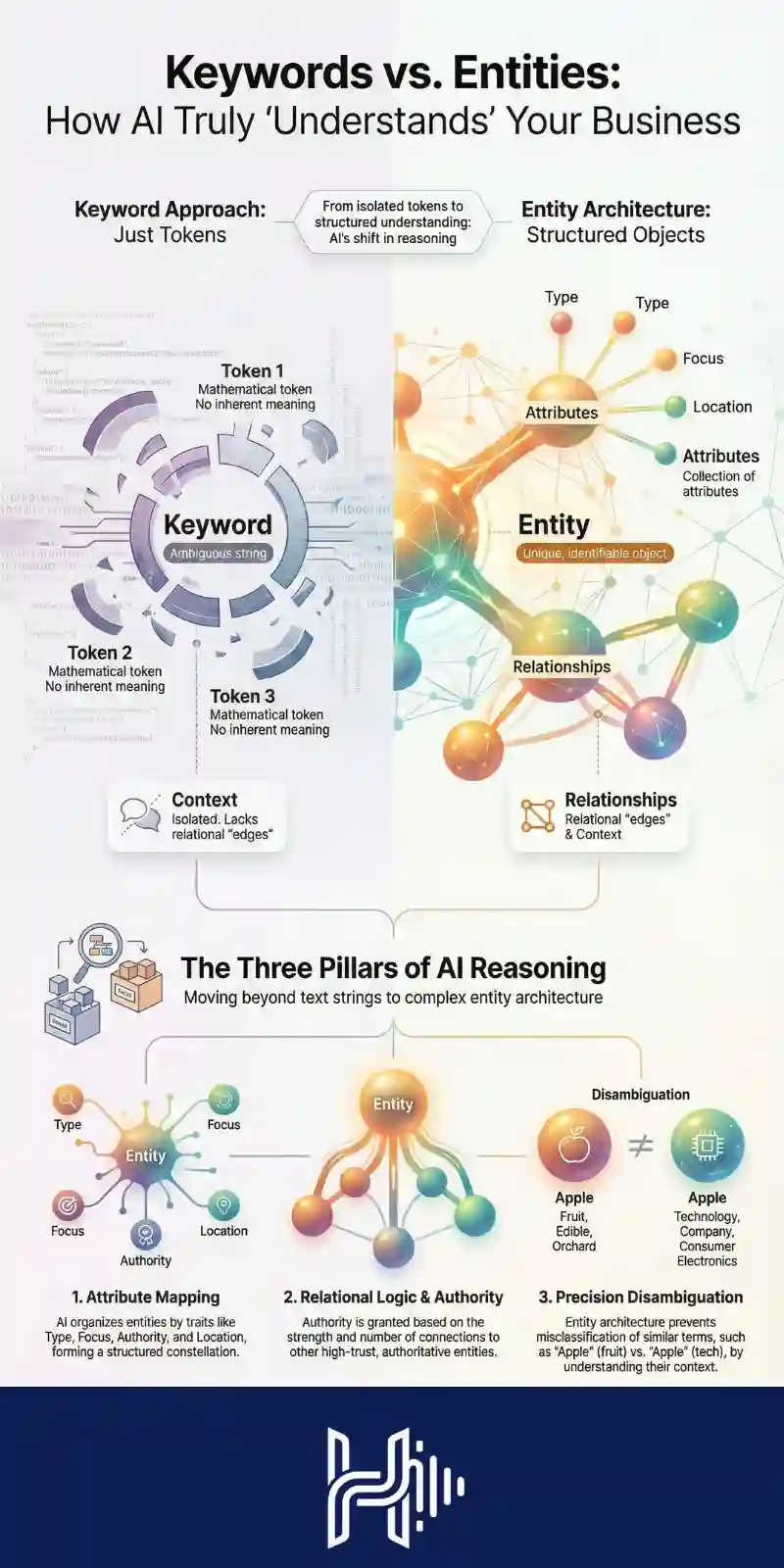
To an LLM, a keyword is just a mathematical token with no inherent meaning. An entity, however, is a uniquely identifiable object or concept defined by its attributes and relationships.
- Attribute Mapping: AI understands an entity like "Holoul Digital" not as a phrase, but as a collection of attributes: [Type: Consulting], [Focus: AI Architecture], [Authority: High], [Location: MENA].
- Relational Logic: AI evaluates the strength of the "edges" between entities. If your entity is frequently associated with "Digital Transformation" and "Executive Strategy" in high-trust datasets, the AI grants you higher authority in those domains.
- Disambiguation: Keywords are ambiguous (e.g., "Apple" could be a fruit or a tech giant). Entity architecture removes this ambiguity, ensuring AI never misclassifies your business.
Business Impact: Precision vs. Noise
Relying on keywords creates "noise" that confuses AI models. Adopting an entity-based approach provides "precision" that drives higher-value outcomes.
-
1
Search Intent Alignment
AI can match your entity to a user's intent even if the user doesn't use your specific keywords. This captures leads that competitors miss.
-
2
Global Authority
Entities are language-agnostic. A correctly architected entity is understood by AI in English, Arabic, or Mandarin, regardless of the specific translated keywords.
-
3
Future-Proofing
Algorithms change; entities do not. As long as your business's identity and relationships are clearly defined, you will remain visible across all future AI models.
Common Misconceptions: The Metadata Trap
Many businesses believe they are doing "entity SEO" because they use basic tags. This is a misunderstanding of the architectural depth required.
-
1
Tags vs. Knowledge Graphs
Adding a few keywords in the backend is not entity building. Entity building is the creation of a local Knowledge Graph that connects your insights, services, and people.
-
2
Content Volume vs. Contextual Density
Writing 100 articles on "AI" is less effective than creating 10 articles that perfectly define your entity's unique position within the AI ecosystem.
-
3
Ignoring External Nodes
Entity architecture doesn't stop at your website. It requires ensuring that the entire web—from LinkedIn to industry databases—confirms the same architectural facts about your business.
Architectural Insight: The Road to Semantic Authority
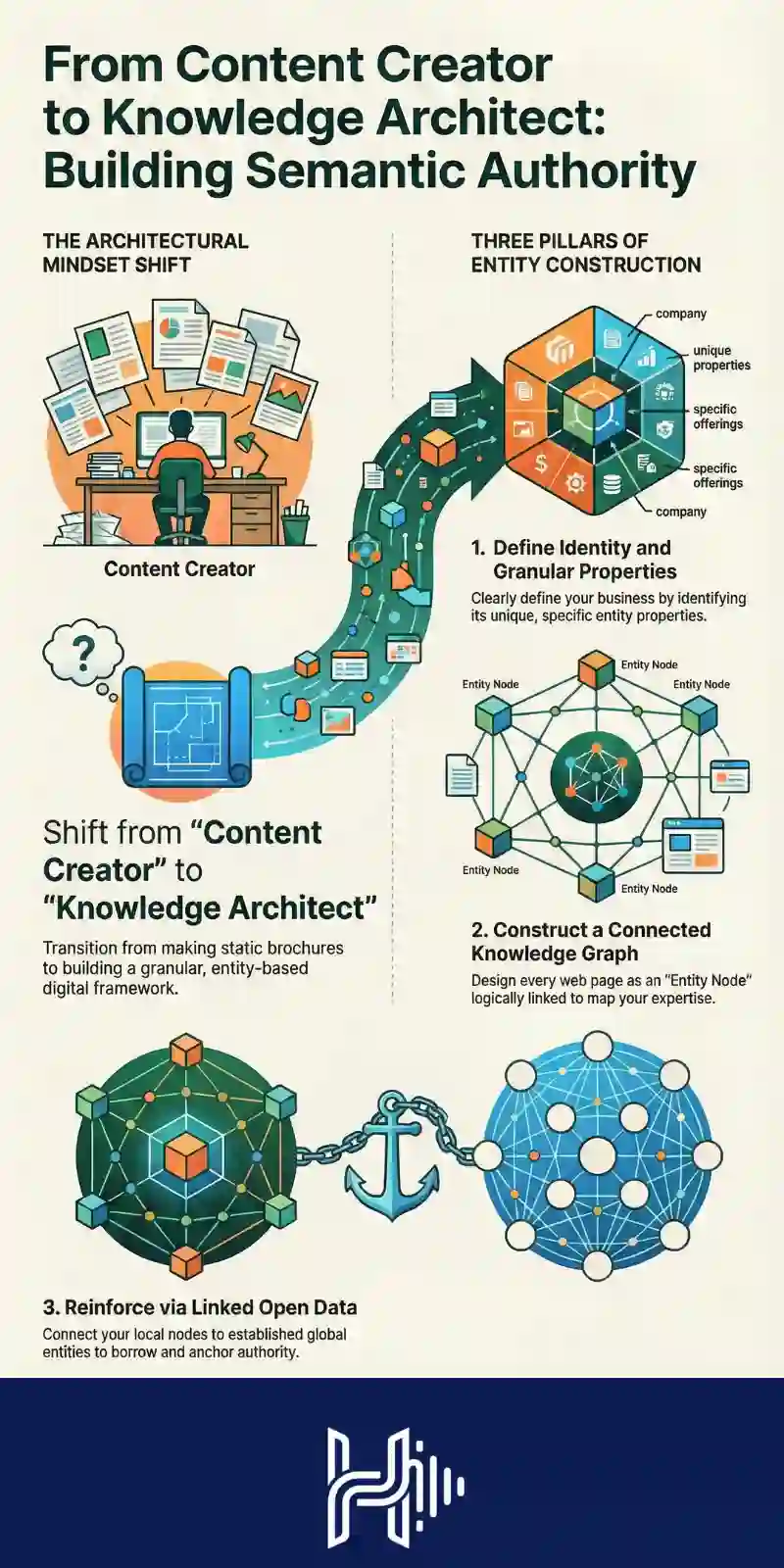
The shift to entity-based architecture requires a mental model change from "content creator" to "knowledge architect."
- Identity Definition: Define your business in the most granular way possible. What are the unique "properties" of your entity?
- Graph Construction: Build your website so that every page is an "Entity Node" connected logically to others. This creates a map that AI can follow to understand your full expertise.
- Entity Reinforcement: Use Linked Open Data to connect your entity to established global entities. This "borrows" authority from the wider web and anchors your business in the global knowledge structure.
The correct architectural approach treats your digital presence as a living map, not a static brochure.
TL;DR
- Keywords vs. Entities: Keywords are what users type; entities are what businesses actually are in the eyes of AI.
- Semantic Mapping: AI ranks businesses based on the strength of their attributes and their relationships to other authoritative concepts.
- Precision and Intent: Entity architecture allows AI to find your business based on the meaning of a query, not just the words used.
- Durability: Unlike keyword rankings, entity-based authority is resilient to algorithm updates and language barriers.
Advisory Note: If you want AI to treat your business as an authority, you must stop ranking for words and start building an entity. Architecture is the only sustainable competitive advantage.


