
The Logic of Inclusion and Exclusion
In an AI-centric digital landscape, visibility is binary: you are either part of the generated answer, or you are invisible. Unlike traditional search engines that offer pages of results, AI interfaces like ChatGPT, Perplexity, and Google Gemini provide a singular, synthesized response. To appear inside these answers, a business must transcend being a website and become a "recognized entity" within the AI's training data and retrieval systems.
How LLMs Reason About Your Presence
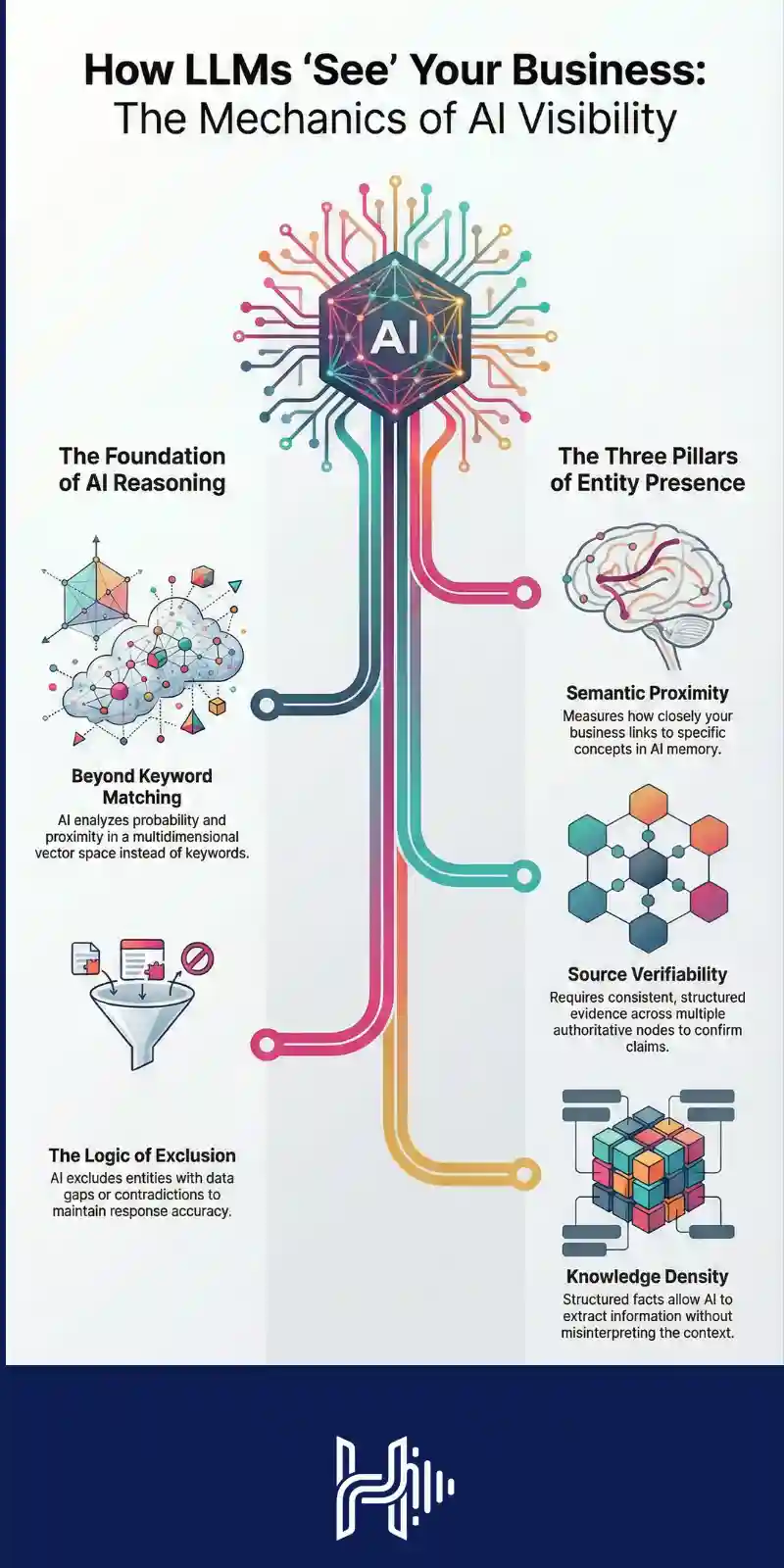
Generative engines operate through a combination of Pre-trained Knowledge and Retrieval-Augmented Generation (RAG). When an AI processes a query about a specific industry or service, it doesn't look for keywords; it looks for Probability and Proximity.
- Semantic Proximity: How closely is your business entity linked to specific concepts in the AI's multidimensional vector space?
- Source Verifiability: Does the AI find consistent, structured evidence across multiple authoritative nodes that confirms your entity's claims?
- Knowledge Density: Is your data structured in a way that allows the AI to extract specific facts without "hallucinating" or misinterpreting the context?
If the AI perceives a gap in your data architecture or a contradiction in your entity's signals, it will exclude you to maintain the accuracy of its response.
Business Impact: The Authority Gap
Disappearing from AI answers is not just a marketing failure; it is a strategic threat. When an AI omits a business, it implicitly signals to the user that the business is not a relevant leader in its field.
- Trust Erasure: If a user asks for "the most reliable architects in London" and an AI fails to mention a prominent firm, that firm's perceived authority drops instantly in the user's mind.
- Zero-Click Exclusion: Because users increasingly rely on the AI's summary without clicking through to external sites, being excluded means your brand exists outside the user's conscious decision set.
- Revenue Displacement: Competitors who have successfully engineered their digital entities will capture the entirety of the demand generated within the AI interface.
Common Misconceptions: The Content Volume Myth
The most common error businesses make is attempting to "flood the zone" with content. In the AI era, volume is often counterproductive.
- Keywords are not Entities: Ranking for "digital consulting" does not mean ChatGPT recognizes you as a "Digital Consultant." One is a linguistic match; the other is a semantic identity.
- Backlinks are not Citations: Traditional backlinks help with search rankings, but AI models look for "Co-occurrence"—the frequency and context in which your entity is mentioned alongside industry leaders and core concepts.
- Static Sites are Dead: A website that is just a collection of pages is unreadable to an AI trying to map a business ecosystem.
Architectural Insight: Building for Retrieval
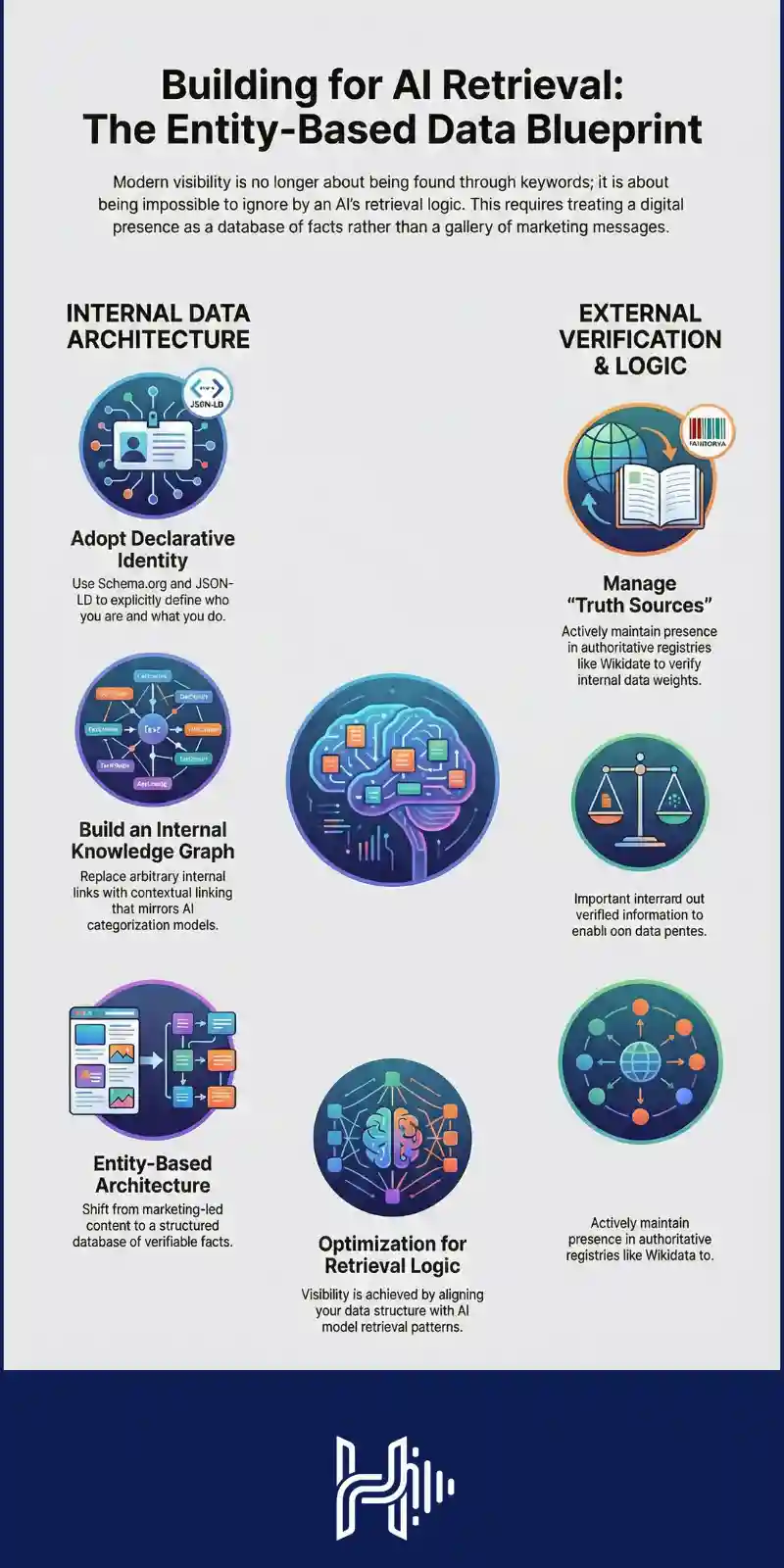
To ensure appearance within AI answers, businesses must adopt Entity-Based Data Architecture. This means treating your digital presence as a database of facts rather than a gallery of marketing messages.
- Declarative Identity: Use Schema.org and JSON-LD to explicitly tell AI models who you are, what you do, and what entities you are related to.
- Contextual Linking: Instead of arbitrary internal linking, build a "Knowledge Graph" within your site that mirrors how AI models categorize information.
- Entity Validation: Actively manage your presence in external "Truth Sources" (Wikidata, industry registries, and authoritative journals) that AI models use to verify their internal weights.
Visibility today is not a result of "being found"; it is a result of being "impossible to ignore" by the AI's retrieval logic.
TL;DR
- The Visibility Binary: In AI answers, you are either the cited source or you are invisible.
- Retrieval Logic: AI chooses sources based on semantic proximity, knowledge density, and verifiable entity signals.
- The Authority Gap: Exclusion from AI responses serves as a silent signal of non-relevance to the user.
- Architecture vs. Volume: AI values the structured integrity of a digital entity over the sheer volume of marketing content.
Advisory Note: The correct architectural approach ensures that your business is not just another data point, but a primary reference in the AI's knowledge map. Visibility is designed, not optimized.


