
The Financial Value of Machine Readability
In the modern economy, the distance between a business's data and a transaction is mediated by an AI's ability to parse information. We are moving toward a "Machine-to-Machine" economy where AI agents negotiate, filter, and recommend products or services to human decision-makers. In this environment, Structured Data Architecture is not a technical detail; it is a direct driver of revenue. If an AI cannot quantify your value proposition through structured facts, that value effectively does not exist in the digital marketplace.
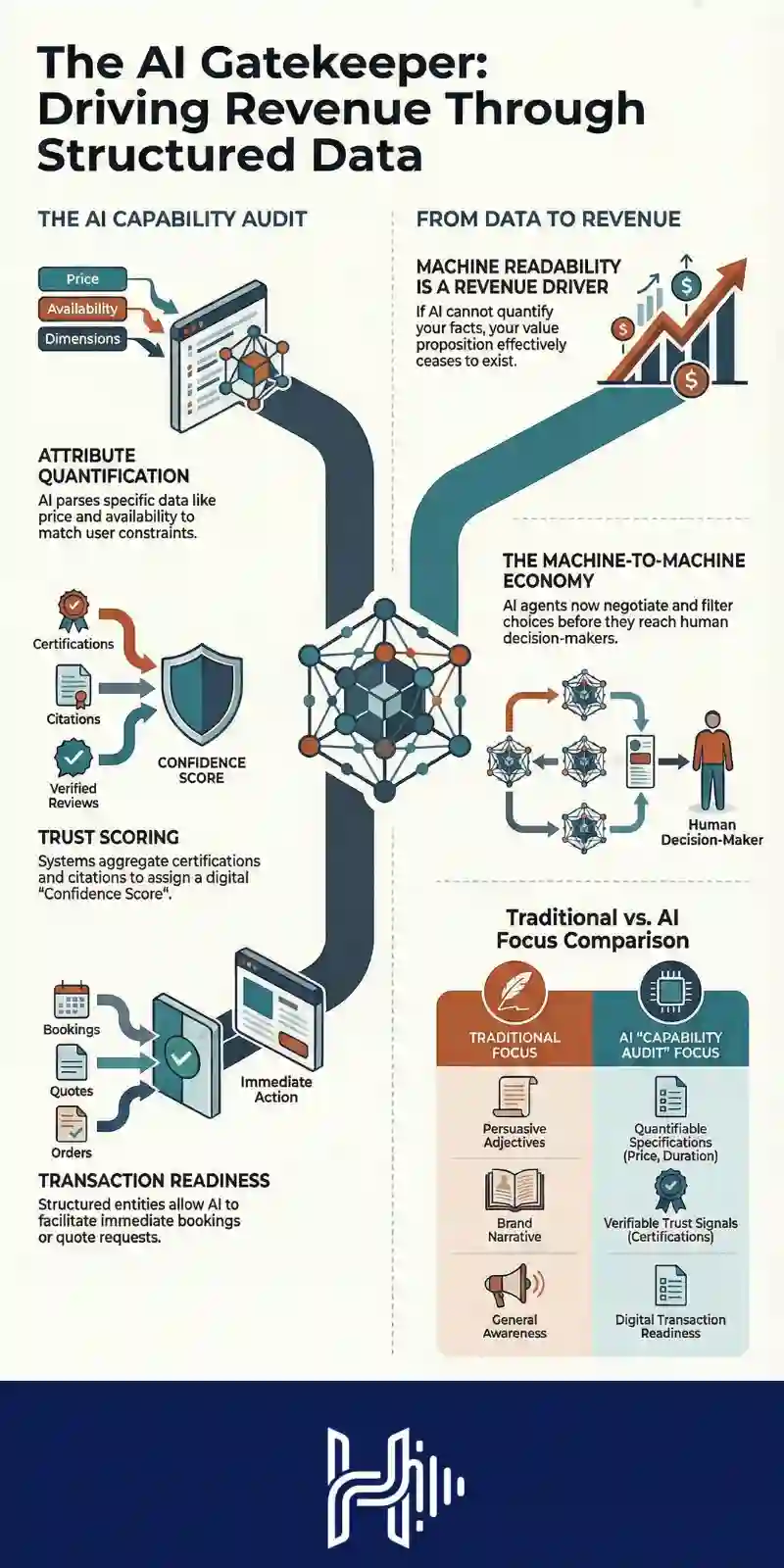
How AI Processes Data to Drive Conversions
When a generative engine or an AI agent evaluates a business for a potential purchase or recommendation, it performs a Capability Audit. It doesn't look for persuasive adjectives; it looks for verifiable data points.
-
1
Attribute Quantification
AI looks for structured specifications (price, duration, availability, specific outcomes) to compare against user constraints.
-
2
Trust Scoring
AI synthesizes structured signals from reviews, certifications, and third-party citations to assign a "Confidence Score" to the business.
-
3
Transaction Readiness
AI identifies whether the business's digital entity is structured to facilitate the next step in the buyer's journey (e.g., booking a consultation or requesting a quote).
Without structured data, the AI cannot "vouch" for the business, leading to a direct loss in sales opportunities.
Business Impact: The ROI of Clarity
The impact of correct data architecture on revenue is measurable through the lens of efficiency and conversion.
-
1
Higher Lead Quality
Because AI only recommends businesses that semantically match the user's complex needs, the leads that arrive are already "pre-sold" by the AI's synthesis.
-
2
Reduced Customer Acquisition Cost (CAC)
When your business is naturally cited by AI as a primary solution, the reliance on expensive paid advertising decreases.
-
3
Brand Premium
Being the "chosen" entity in an AI response allows for premium positioning. Users perceive the AI's recommendation as an objective endorsement, reducing price sensitivity.
Common Misconceptions: Schema is Not Strategy
Most businesses treat structured data (Schema) as a "check-the-box" SEO task. This superficial approach fails to impact revenue.
- Standard vs. Custom Schema: Using basic "Organization" or "WebSite" schema is the bare minimum. Revenue-driving architecture requires custom entity mapping that defines the unique logic of your business model.
- Data Integrity vs. Marketing Fluff: AI models are increasingly sensitive to "Schema Spam"—where the structured data doesn't match the actual content. This results in architectural penalties.
- Internal vs. External Data: Revenue is impacted not just by what is on your site, but by how your structured data connects to the global ecosystem of information.
Architectural Insight: Engineering the Sales-Ready Entity
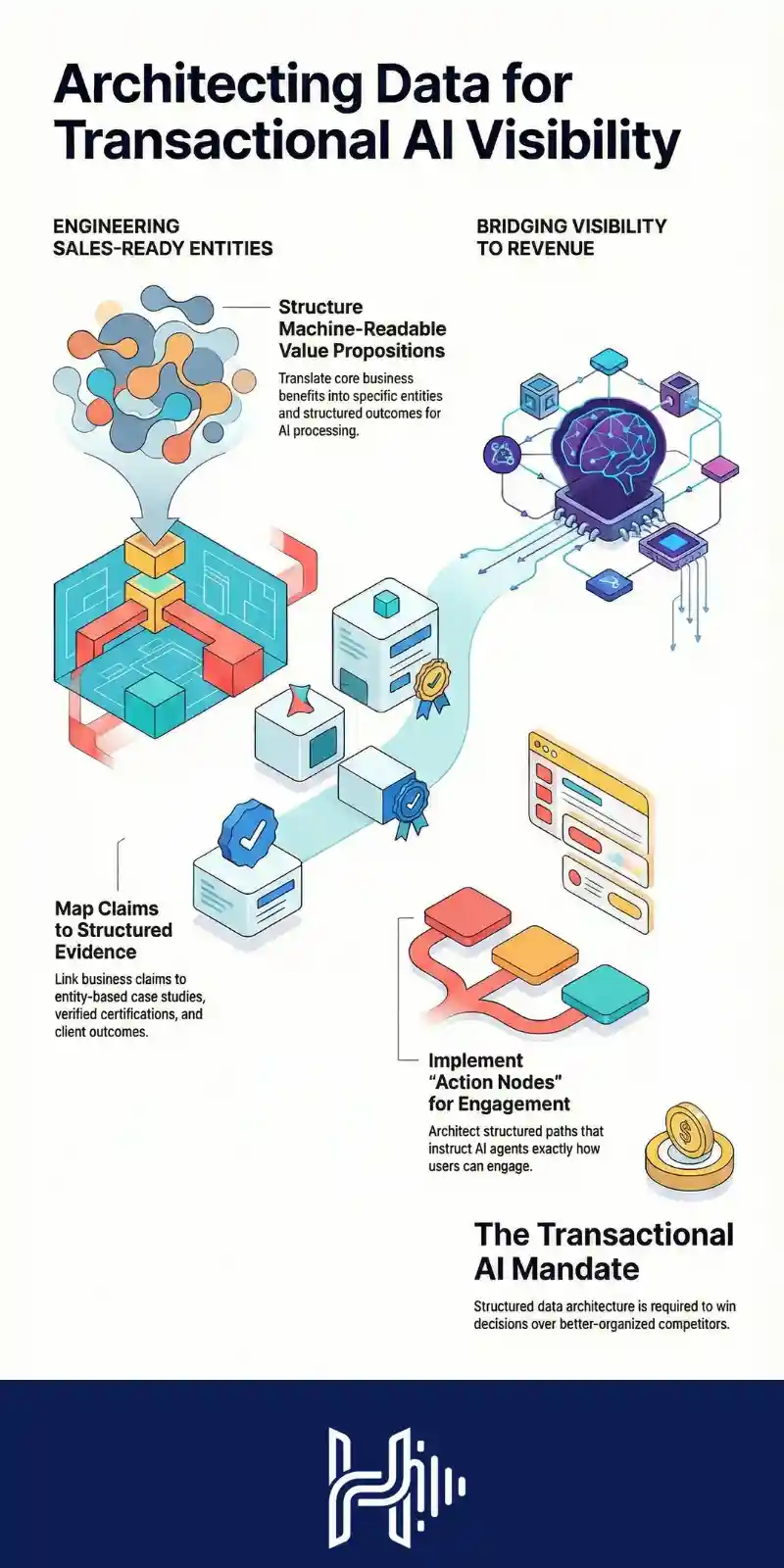
To turn AI visibility into revenue, a business must architect its data for Transaction-Oriented Retrieval.
- Value Proposition Structuring: Translate your core business benefits into machine-readable formats. If you offer "strategic guidance," define exactly what entities that guidance impacts and what the structured outcomes are.
- Evidence-Based Mapping: Link your claims to structured evidence (case studies defined as entities, certifications from recognized bodies, and verified client outcomes).
- Bridge to Action: Ensure your entity architecture includes "Action Nodes"—structured paths that tell an AI agent exactly how a user can engage with your business.
Visibility today is designed to lead to a decision. If the data is not structured, the decision will go to a competitor.
TL;DR
- Machine-Ready Sales: Revenue in an AI-driven market depends on how easily an AI can parse and verify your business's value proposition.
- Capability Audits: AI performs audits of businesses based on structured attributes, not marketing copy.
- The Confidence Score: Structured data provides the verifiable signals that AI needs to recommend a business with high confidence.
- Actionable Architecture: Revenue-focused data architecture includes clear paths for AI agents to move users from "discovery" to "transaction."
Advisory Note: If you want AI to drive revenue to your business, the architecture of your data must be as precise as your business strategy. Visibility today is designed, not optimized.


