
The Shift from Search to Synthesis
The traditional linear path of the buyer's journey—moving from a keyword search to a list of links—is being replaced by a process of AI-mediated synthesis. In this new paradigm, users no longer aggregate information themselves; instead, they interact with Generative AI interfaces that provide definitive summaries, comparisons, and recommendations.
Influence Is No Longer About Clicks—It's About Entity Construction
For businesses, this shift represents a fundamental change in how influence is exerted. Influence is no longer about winning a click on a search engine results page (SERP); it is about being the primary entity that the AI uses to construct its narrative. When an AI decision engine influences a user, it does so by framing the context of the choice before the user even visits a brand's digital property.
How AI Interprets the Decision-Making Process
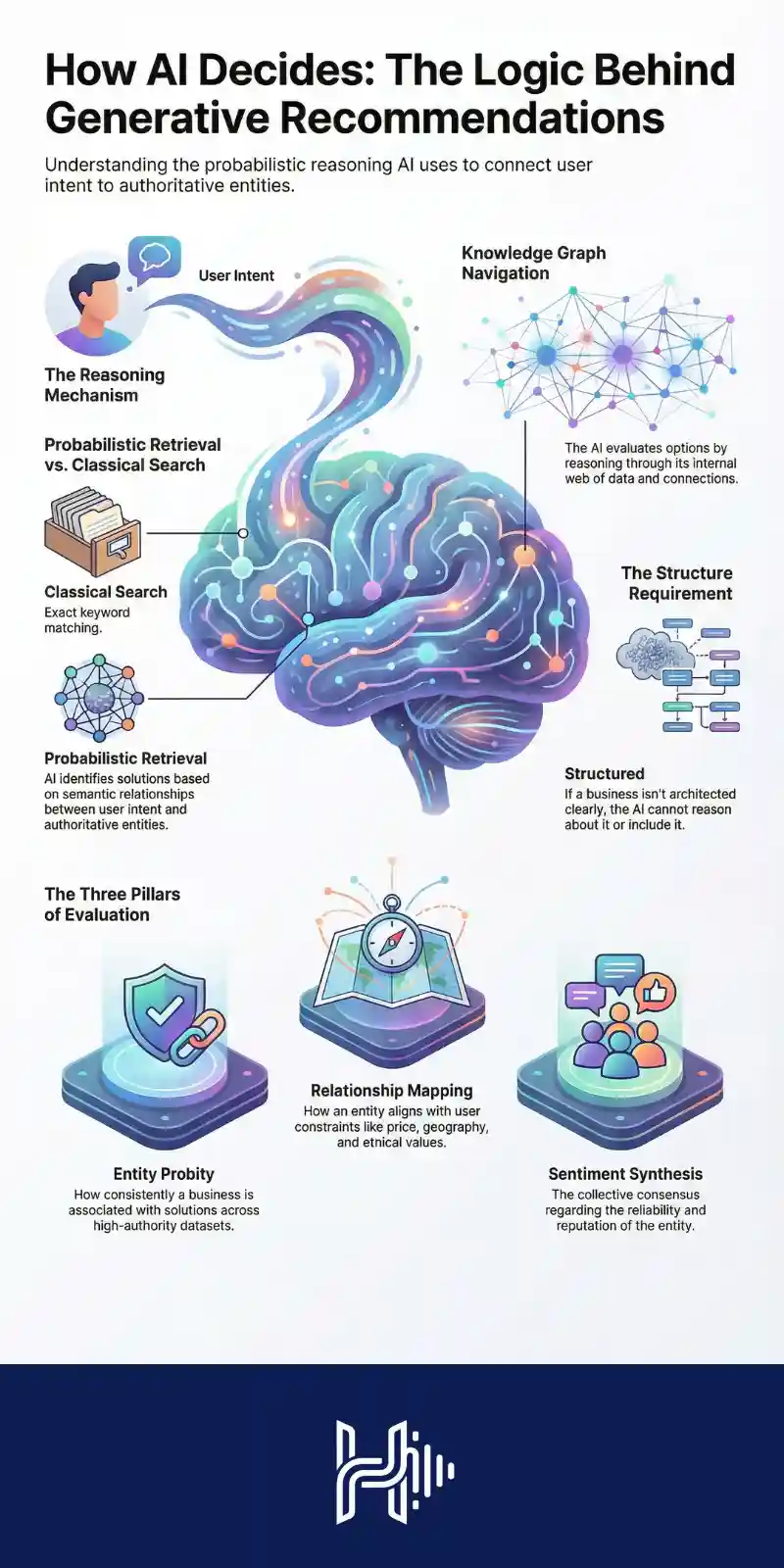
Large Language Models (LLMs) and generative systems do not "search" in the classical sense. They perform a probabilistic retrieval of information based on the semantic relationship between a user's intent and the entities it recognizes as authoritative.
When a user asks for a solution, the AI reasons through its internal knowledge graph. It evaluates:
- Entity Probity: How consistently is this business associated with a specific solution across high-authority datasets?
- Relationship Mapping: How does this entity relate to the user's specific constraints (price, quality, geography, or ethical values)?
- Sentiment Synthesis: What is the collective consensus regarding this entity's reliability?
If a business is not architected as a clear, structured entity, the AI cannot "reason" about it, leading to its exclusion from the synthesis provided to the user. This begins with designing a website optimized for AI.
Business Impact: The Loss of the Invisible Lead
The most significant impact of AI on business revenue is "the Invisible Lead." These are potential customers who have been steered toward or away from a business by an AI summary before they ever entered the business's own analytics tracking.
- Pre-emptive Trust: Users grant immediate trust to entities that AI models present as the "top choice" or "most reliable."
- Compressed Funnels: The distance between "awareness" and "decision" is shrinking. AI provides the comparison and the verdict in one response.
- Competitive Displacement: In an AI-driven environment, the second-best option is often not shown at all. The "winner-take-most" nature of AI answers creates a high-stakes environment for digital visibility.
Common Misconceptions: The Visibility Trap
Many businesses believe that high traffic equates to influence. In the age of AI, this is a fallacy. Traditional SEO focused on capturing traffic through broad keywords, but AI-driven decisions are based on Entity Authority.
Businesses often mistakenly prioritize:
- Keyword Volume over Semantic Clarity: They rank for words but fail to be recognized as a distinct entity.
- Content Quantity over Data Integrity: They publish blogs that AI identifies as low-signal "noise," which hurts their overall architectural standing.
- User Clicks over Citation Value: They optimize for the human eye while ignoring the machine-readable structure that allows AI to cite them as a source.
Architectural Insight: Engineering the Path of Influence
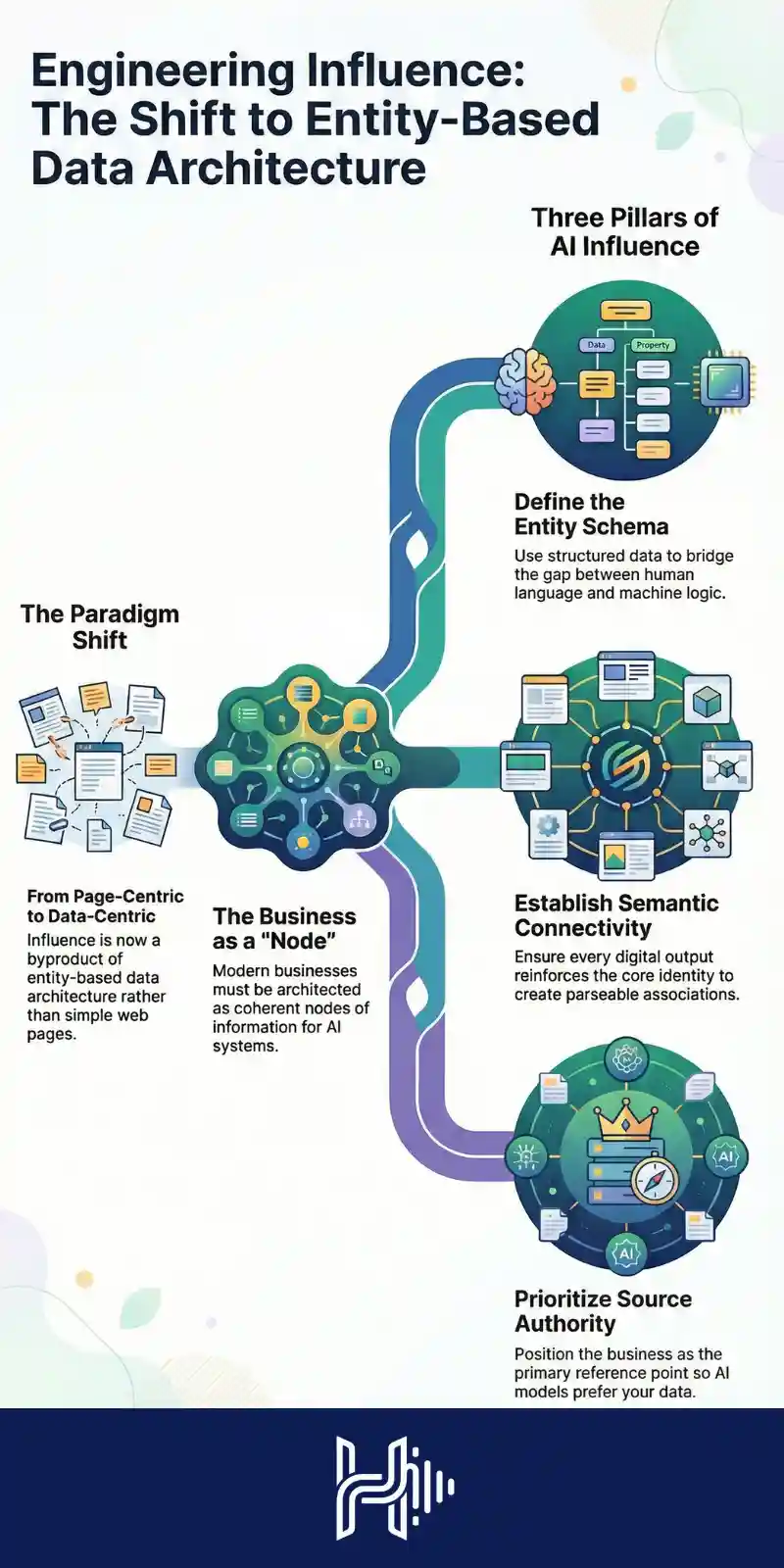
Influence in the generative era is a byproduct of Entity-Based Data Architecture. This approach moves away from the "page-centric" model of the internet and toward a "data-centric" model.
To influence an AI's decision-making process, a business must be architected as a coherent node of information. This involves:
- Defining the Entity Schema: Clearly articulating what the business is, what it does, and who it serves using structured data that bridges the gap between human language and machine logic.
- Establishing Semantic Connectivity: Ensuring that every piece of digital output reinforces the core identity of the business, creating a dense web of associations that AI models can easily parse.
- Prioritizing Source Authority: Positioning the business as a reference point for specific knowledge so that AI models "prefer" to cite it when synthesizing answers.
Visibility today is not found; it is engineered.
TL;DR
- Shift in Behavior: AI has transitioned the buyer's journey from "searching for links" to "receiving synthesized verdicts."
- Decision Framing: AI influences users by framing the context of a purchase before a user ever visits a company website.
- Architecture over Optimization: Influence is achieved through a structured Entity-Based Data Architecture that allows AI to recognize and trust a business.
- The Invisible Funnel: Businesses are losing or winning customers inside the AI interface, making traditional SEO metrics less relevant.
Advisory Note: If you want AI to understand your business correctly, the architecture comes first. Visibility in the age of generative engines is a matter of strategic design, not mere optimization.


